
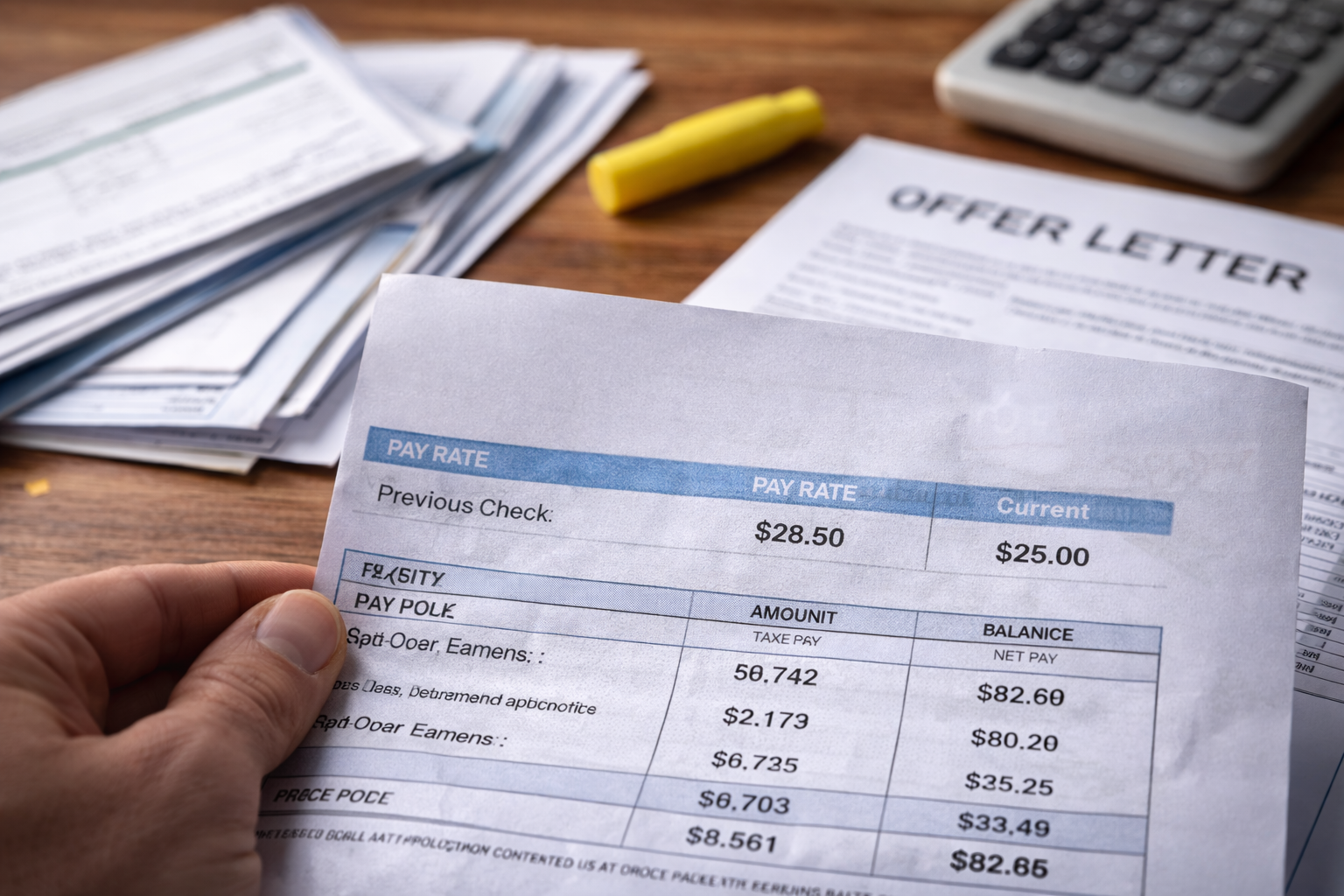
Employer Reduced My Pay Without Written Notice — I caught it the same way most people do: not in a meeting, not in an email, but on the pay stub. The deposit was lower, and at first I blamed taxes. Then I saw the hourly rate field. It had changed. No heads-up. No message. Just a smaller number tied to my name like it had always been that way.
I sat there with the stub open, scrolling back through prior checks, trying to find the “explanation” I must have missed. There wasn’t one. My schedule didn’t change. My role didn’t change. I didn’t sign anything. That’s when it hit me: if I don’t create a written record now, the reduced rate becomes the new history. If Employer Reduced My Pay Without Written Notice happened to you, your goal is to lock down proof, force a clear answer in writing, and stop the mistake (or the policy) from spreading into overtime, benefits, and future checks.
Start With One Question: Error or Decision?
Employer Reduced My Pay Without Written Notice can be either a payroll coding mistake or a deliberate compensation decision. Your approach changes depending on which one it is, and you can usually identify it by the pattern.
If it’s an error: one pay period is off, the rate field looks “odd,” or the pay code is different than usual.
If it’s a decision: the rate is cleanly updated, the change carries forward, and managers speak in vague “company policy” language.
You don’t accuse. You classify. Employer Reduced My Pay Without Written Notice becomes solvable when you pin it to a category and ask for a specific document.
If your manager is already using the “payroll issue” language, this page helps you decode that playbook:
Freeze Proof Before You Talk to Anyone
Before HR or payroll can “correct the record,” preserve the old record. Employer Reduced My Pay Without Written Notice is a documentation race, and you want your file ready before the first conversation.
- At least 3 prior pay stubs showing the established rate
- The first pay stub showing the reduced rate
- Your offer letter, comp plan, or written wage confirmation
- Time records / schedules for the affected pay period
- Any email or message about role, status, or pay changes (even vague ones)
If you only do one thing today, download the stubs. Employer Reduced My Pay Without Written Notice cases get harder when prior portal access disappears after termination or role changes.
Match Your Situation to the Right Track
Use the boxes below to locate your exact version of Employer Reduced My Pay Without Written Notice. Each track has a different “best next sentence” to send in writing.
Track A: The rate changed, but your title and duties did not
Most likely payroll coding error or unauthorized manager action.
Track B: The employer says you were reclassified (hourly/salary/exempt status)
Requires documentation of effective date and classification basis.
Track C: The employer ties the reduction to performance or discipline
Requires written notice, policy reference, and prospective-only application.
Track D: The employer claims “company-wide reduction” or budget cut
Requires written notice, effective date, and confirmation it is not retroactive.
Track E: Your paycheck looks reduced due to deductions, not rate
May be an unauthorized deduction problem disguised as a wage cut.
Employer Reduced My Pay Without Written Notice often starts as Track A or E. Don’t let them steer you into “you agreed” if you didn’t.
Track A: Same Job, Lower Rate
If Employer Reduced My Pay Without Written Notice happened with no role change, treat it as a payroll integrity issue and ask for the “who/what/when” behind the change.
Written request you can send:
“My pay rate appears reduced on the most recent pay statement. Please confirm (1) the effective date of any rate change, (2) who authorized it, and (3) whether the change was intended or an error. Please also confirm the rate that applies to hours already worked.”
That last sentence matters. Employer Reduced My Pay Without Written Notice becomes a wage claim when hours already worked are paid at the reduced rate.
Track B: Reclassification (Hourly, Salary, Exempt Status)
Sometimes Employer Reduced My Pay Without Written Notice is explained as “we updated your status.” Reclassification can affect overtime eligibility, benefits, and how your pay is calculated.
If classification is in play, compare your situation to this related issue:
What to demand in writing:
- The new classification and the date it became effective
- Whether the change alters overtime eligibility
- Whether base pay or hours expectation changed
- Whether you are being asked to sign an updated wage notice or agreement
Employer Reduced My Pay Without Written Notice paired with reclassification can create hidden overtime and back-pay exposure for the company. That’s why they often try to keep it informal.
Track C: Performance or Discipline Pay Cut
If Employer Reduced My Pay Without Written Notice is framed as performance-related, the risk is that they try to apply it retroactively or quietly. Even when employers can adjust pay prospectively in many states, retroactive reduction for hours already worked is a major legal red flag.
Clarify these points:
- Is the reduction prospective only?
- What policy governs pay changes tied to performance?
- Was notice provided before the pay period began?
Do not debate whether you “deserved it.” Employer Reduced My Pay Without Written Notice is about notice and timing, not opinions.
Track D: Company-Wide Pay Reduction
Budget cuts happen. But Employer Reduced My Pay Without Written Notice becomes problematic when the company applies it without clear effective dates or communicates inconsistently across teams.
Ask for these facts:
- The date the reduction began
- Whether it impacts base rate, shift differentials, or bonuses
- Whether it changes overtime calculations
- Whether the reduction is temporary and how restoration will be documented
“Temporary” reductions often become permanent when nothing is written down.
Track E: It’s Not the Rate — It’s a Deduction Disguised as a Cut
Sometimes Employer Reduced My Pay Without Written Notice is actually a deduction: uniform, equipment, cash shortage, training cost, benefit adjustment, or repayment. It feels like a pay cut because take-home is lower.
If the stub shows a new deduction line, compare your situation here:
What to check:
- Is there a new deduction code or description?
- Is there written authorization on file?
- Does the deduction push you below minimum wage for the pay period?
Employer Reduced My Pay Without Written Notice often gets misdiagnosed until you separate “rate” from “take-home.”
Overtime, PTO, and Bonus Ripple Effects
Employer Reduced My Pay Without Written Notice can quietly change more than base pay. It can lower overtime rates, reduce PTO payout value in some systems, and alter bonus/commission calculations if they are percentage-based.
- If overtime is involved, compare against your hours and approvals.
- If bonuses are tied to base salary, confirm whether your plan allows changes mid-cycle.
- If you recently had a promotion, check whether the system reverted your pay grade.
Small reductions become large losses when overtime is recalculated for multiple pay periods.
The “Two-Email” Method That Forces Clarity
If Employer Reduced My Pay Without Written Notice is not corrected within one payroll cycle, use a two-email sequence: one to payroll/HR, one to your manager. Keep both factual.
Email 1 (Payroll/HR): request effective date, authorization source, and confirmation of the correct rate for already-worked hours.
Email 2 (Manager): request confirmation whether the rate change was intended and whether you are expected to continue working at the new rate.
This removes the “we never knew” excuse.
One Official Source You Can Cite
For federal standards on wages and overtime, use the official Wage and Hour Division page:
U.S. Department of Labor – Wage and Hour Division
Mistakes That Make This Harder Later
- Continuing to work for months without any written objection
- Accepting verbal explanations without effective dates
- Paying back “overpayment” claims via deductions without documentation
- Quitting immediately and losing access to pay records
Employer Reduced My Pay Without Written Notice becomes “consent” only when silence lasts long enough.
FAQ
Can an employer reduce my pay without written notice?
In many places, employers can change pay going forward, but they generally cannot reduce pay retroactively for hours already worked. Document and confirm the effective date.
What if they say the rate was always correct?
Show prior pay stubs and your offer letter. Employer Reduced My Pay Without Written Notice disputes are often resolved by simple comparison.
Should I file a wage complaint immediately?
Start with written clarification and correction request first. Escalate if the employer refuses to correct or explain.
What if the reduction pushes me below minimum wage?
That is urgent. Capture the stub and request immediate correction in writing.
Can this affect my benefits or retirement contributions?
Yes. Lower wages can change contribution amounts and benefit eligibility thresholds depending on plan rules.
Key Takeaways
- Employer Reduced My Pay Without Written Notice is either an error or a decision—classify first, then act.
- Freeze proof: pay stubs, offer letter, time records, and deduction codes.
- Use the correct track (A–E) so you ask for the right documents immediately.
- Don’t let a rate change touch hours already worked without written confirmation and correction.
- Keep everything in writing so the reduced rate doesn’t become “history.”
Employer Reduced My Pay Without Written Notice felt deceptively small at first — just a smaller deposit. But what made it stressful wasn’t the single check. It was the idea that if I didn’t respond quickly, the system would treat this rate as the truth going forward. That’s why you focus on records, not arguments.
If Employer Reduced My Pay Without Written Notice happened on your most recent paycheck, do this today: download prior stubs, save the current stub, send a written request asking for the effective date and authorization source, and demand confirmation that hours already worked are paid at the original rate. Do not accept a verbal explanation, do not wait for the next paycheck, and do not keep working under a new rate without written confirmation. Those steps protect you immediately without escalating unnecessarily.