
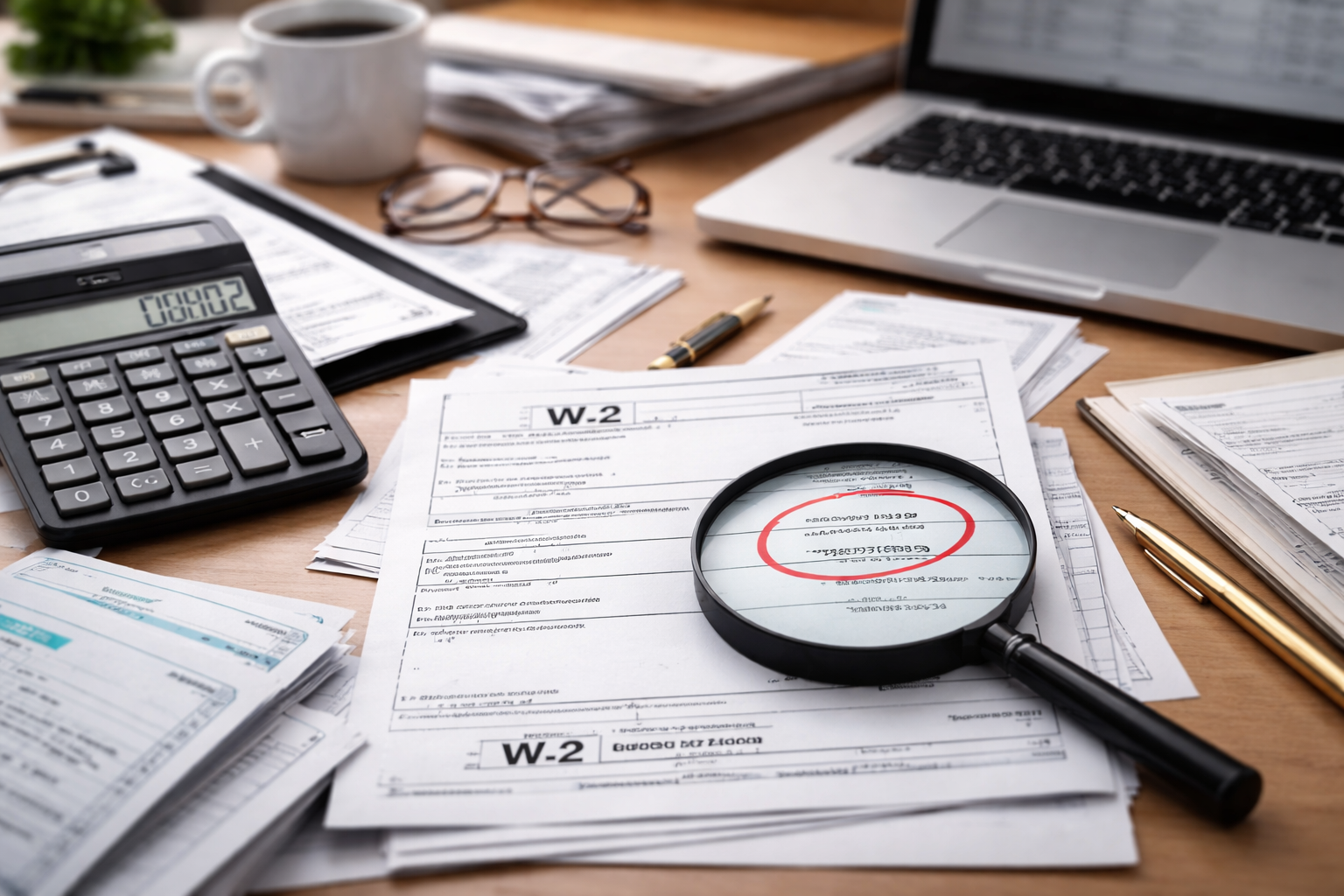
Employer Reported Wrong Wages on W-2 was the exact phrase I searched after staring at the form longer than I wanted to admit. I had opened it expecting the usual routine: download, review, move on. Instead, the number on the page pulled me up short. It looked too high. Not slightly off in a way that could be explained by memory, but wrong in a way that made me go back through old pay stubs one by one. The more I checked, the less it looked like a misunderstanding and the more it looked like a reporting problem that had already gone further than I had.
That is the worst part of this kind of mistake. The problem does not begin when you notice it. It usually begins weeks or months earlier inside payroll records you never see. By the time Employer Reported Wrong Wages on W-2 shows up in front of you, the employer may already have finalized year-end reporting and sent data forward. If the number on the form does not match what you were actually paid, the issue needs to be handled before you file, not after the return has already been submitted.
If the year already included odd payroll activity, missing deposits, reversals, or unresolved pay adjustments, it helps to understand how payroll systems identify mismatches before they become formal reporting errors.
Read this background guide first if you want the system view of how these issues get flagged internally.
Why this problem feels bigger than a normal payroll error
A late paycheck is stressful. A missing overtime line is frustrating. But Employer Reported Wrong Wages on W-2 hits differently because it turns a payroll problem into a tax record problem. Once that happens, the question is no longer just whether payroll made an adjustment correctly. The question becomes whether the employer has officially reported income that does not reflect reality.
Employees usually notice this in one of three moments. The first is when the W-2 total is visibly higher than the total earnings they remember receiving. The second is when federal withholding looks strange compared with prior pay stubs. The third is when a year-end bonus, reversal, correction, or deduction issue suddenly makes the whole form stop making sense. In all three situations, the same concern starts to settle in: if this number is wrong here, where else was it sent?
That is why this issue should be treated as a records problem first and a filing problem second. If you focus only on getting taxes done quickly, you may miss the chance to correct the underlying payroll report before it causes a longer chain of problems.
Quick self-check before contacting payroll
- Compare Box 1 wages against the total of your final year-to-date gross pay
- Check whether Social Security and Medicare wage figures also look off
- Review whether a bonus, retro pay item, or reversal happened late in the year
- Look for deductions that changed mid-year, especially pre-tax deductions
- Save copies of your pay stubs before opening a payroll ticket
Where Employer Reported Wrong Wages on W-2 usually starts
Most employees imagine this kind of problem begins with a typo. Sometimes it does, but not often. More commonly, Employer Reported Wrong Wages on W-2 grows out of a chain of system events that looked separate at the time. Payroll systems pull from timekeeping data, benefit deductions, compensation adjustments, prior corrections, and tax configuration rules. A form can end up wrong even when each individual payroll cycle looked ordinary enough on the surface.
That is especially true when the year included unusual events such as a pay rate change, unpaid leave, promotion correction, bonus dispute, garnishment, overpayment recovery, or employment status update. A payroll department may reconcile those events in the ledger without fully correcting how the wages are classified for year-end reporting. From the employee side, it feels like a brand-new problem. Internally, it may be the final symptom of an older unresolved mismatch.
Several patterns show up repeatedly when Employer Reported Wrong Wages on W-2 appears:
Internal patterns that commonly lead to reporting errors
- Overpayments reversed after the original taxable wages were already recorded
- Late bonus entries posted into the wrong reporting sequence
- Pre-tax deductions treated as post-tax for part of the year
- Retro pay entered incorrectly after a promotion or pay-rate correction
- Status changes between employee and contractor classifications
- Manual payroll adjustments added without synchronized tax treatment
In other words, the W-2 can be wrong even when no single paycheck looked obviously fraudulent or fabricated. The problem often sits in the logic behind the year-end totals.
What the employer is usually checking behind the scenes
When you tell payroll that Employer Reported Wrong Wages on W-2 appears on your tax form, a serious employer will usually start a reconciliation review. That does not always happen quickly, but the review itself tends to follow a pattern. Payroll or HR will compare the wage figure on the form against the year-end payroll register, taxable wage calculations, deduction history, and any off-cycle adjustments.
They may also review whether a correction already happened in the system but was not reflected in the reporting output. This matters because some payroll teams assume that if the internal ledger balances, the tax form must be right. That assumption is not always safe. A ledger can balance while the tax classification layer still contains the wrong wage treatment.
Employers often test a few specific questions during review:
- Was any pay issued and later clawed back or reversed?
- Did a bonus or commission get moved between periods?
- Were pre-tax deductions applied consistently all year?
- Did the employee move between payroll profiles or work statuses?
- Was there a manual correction after a complaint or ticket?
If the employer confirms the form is wrong, the correction usually takes the form of a W-2c. That is the corrected wage statement employees usually need before filing if the original figure is materially inaccurate. The correction matters not just because the form changes, but because the employer should also update the reporting trail attached to that form.
The situations that matter most in real life
Employer Reported Wrong Wages on W-2 does not play out the same way for everyone. The details matter. The right response depends heavily on what kind of mismatch happened and what part of the year created it. The most useful way to think about it is not as one broad issue, but as several distinct versions of the same problem.
Situation A – The W-2 shows more wages than you actually receivedThis is one of the most urgent versions because it can inflate taxable income and distort your filing. It often happens after a payroll reversal, failed direct deposit replacement, overpayment recovery, or year-end correction that was not cleaned up properly. If you are in this group, your documentation should focus on actual funds received versus taxable wages reported.
Situation B – The W-2 includes a bonus that never actually reached you
This tends to happen when a bonus was approved, loaded, reversed, delayed, or offset somewhere inside payroll. Employees remember the dispute because it was visible at the time, but the year-end form may still count the amount. In this version, payroll has to verify whether the bonus was merely scheduled, actually paid, or only partially reversed.
Situation C – The W-2 wage number is wrong after a pay-rate change
Mid-year rate changes create room for retroactive calculations, especially when the employer corrected wages later. If the adjustment logic was incomplete, the earnings history may not line up with the tax treatment. This version often overlaps with prior compensation disputes and should be documented against both the updated rate and the actual pay received.
Situation D – The form looks wrong because deductions were handled incorrectly
When pre-tax deductions such as retirement or benefit deductions were misapplied, the paycheck itself may have looked close to normal while taxable wage treatment drifted out of alignment. This is one of the easiest versions for employees to miss because the wrong number may not be dramatically large, but it still affects filing accuracy.
Situation E – Classification or status changes created conflicting records
If employment status changed during the year, including onboarding delays, contractor classification issues, or system profile changes, year-end reporting can pull from mismatched wage buckets. In this version, the employer needs to verify not only wage totals but which payroll identity or status was tied to those totals.
These distinctions matter because the correction request should match the cause, not just the symptom. A vague message saying the W-2 looks wrong is weaker than a specific request that points payroll toward the exact category of error.
If your tax numbers started looking wrong because paycheck withholding itself was off during the year, this related article can help connect the earlier payroll issue to the year-end reporting outcome.
This is especially useful when your pay stub and your tax form both seem inconsistent.
What your rights look like from the employee side
Employees are not expected to quietly accept inaccurate wage reporting. If Employer Reported Wrong Wages on W-2 applies to your situation, you have the right to request a clear review and to ask the employer to explain how the wage figure was calculated. That does not mean every disagreement will end instantly, but it does mean you are entitled to more than a casual response saying the system is correct.
The most productive requests are narrow and documented. Ask payroll to review the wage figure against year-to-date pay records, year-end taxable wage totals, deduction treatment, and any reversals or adjustments associated with your employee profile. Keep the request factual. The goal is not to argue first. The goal is to lock the employer into a traceable review process.
If the employer confirms the error, the next step is a corrected form. If the employer pushes back despite clear records, the employee may need to preserve written communications and review official filing guidance before submitting a return based on disputed numbers. Official federal guidance on wage and tax statements is available from the IRS here: IRS Form W-2 guidance.
Mistakes that make this harder to fix
Many W-2 disputes get worse because employees react too fast in the wrong direction. The most common mistake is filing immediately just to get the return over with. That can lock you into correcting two things later instead of one: the payroll record and the tax return that relied on it.
Another mistake is contacting payroll without records in hand. If you simply say the amount looks wrong, the employer may respond with a standard explanation about taxable wages without ever reaching the real issue. The more specific and organized you are, the harder it is for the complaint to be brushed aside as confusion.
Other damaging mistakes include:
- Relying only on memory instead of year-to-date pay documents
- Ignoring a mismatch because the difference seems modest
- Accepting verbal reassurance without a written follow-up
- Failing to save pay stubs, prior tickets, and payroll notices
- Treating a reporting problem like a normal paycheck delay
Once you suspect the form is wrong, the safest move is to freeze the filing process until the wage figure is verified.
What to do now in the right order
If Employer Reported Wrong Wages on W-2 is your situation, the next steps should be simple, direct, and documented. Start by collecting your final pay stub, year-to-date earnings record, and any notices tied to bonuses, reversals, deductions, or rate changes. Then send payroll a written request asking for a wage reconciliation review tied specifically to the W-2 amount.
State what appears wrong, attach the supporting records, and ask whether the employer will issue a corrected W-2c if the discrepancy is confirmed. Keep the message professional and keep it in writing. If earlier payroll problems played a role, reference those dates and payroll events directly. The goal is to move the conversation from opinion to record comparison.
Before you leave the topic, read this next if the issue appears connected to a broader breakdown in wage posting, payment routing, or unresolved payroll corrections during the year.
Key Takeaways
- Employer Reported Wrong Wages on W-2 is usually a year-end reporting problem rooted in older payroll events.
- The mismatch may come from reversals, bonuses, deductions, status changes, or late corrections.
- Employees should compare the W-2 against year-to-date pay records before filing.
- A proper correction usually requires payroll review and, if needed, a W-2c.
- Do not treat a wage-reporting dispute like a minor paycheck issue.
FAQ
Can Employer Reported Wrong Wages on W-2 delay my refund?
Yes. If you file with inaccurate wage data, the return may create follow-up issues, especially when the employer has already reported a different number through official payroll channels.
What if the W-2 number is higher than everything I actually received?
That usually points to a reversal, overpayment recovery, failed correction, or wage classification problem. You should request a written reconciliation review before filing.
Should I wait for a corrected form?
If the wage figure appears materially wrong, waiting for the employer’s review and corrected reporting is often safer than filing first and trying to repair the problem later.
What records matter most?
Your final pay stub, full year-to-date earnings, deduction history, bonus notices, and any payroll tickets or email communications tied to disputed adjustments.
Employer Reported Wrong Wages on W-2 can look like a tax-season surprise, but in most cases it is the final visible sign of a payroll record that went off track earlier. That is why this problem should be handled calmly and precisely. The better your records are, the easier it becomes to force the discussion back onto verifiable numbers instead of vague explanations.
Do not file just to get it over with. Pull your pay records, send a written reconciliation request to payroll, and ask directly whether a corrected W-2c will be issued if the mismatch is confirmed. If Employer Reported Wrong Wages on W-2 appears on your form, the right move is to stop, document, and correct the reporting trail before the filing trail gets built on top of it.