
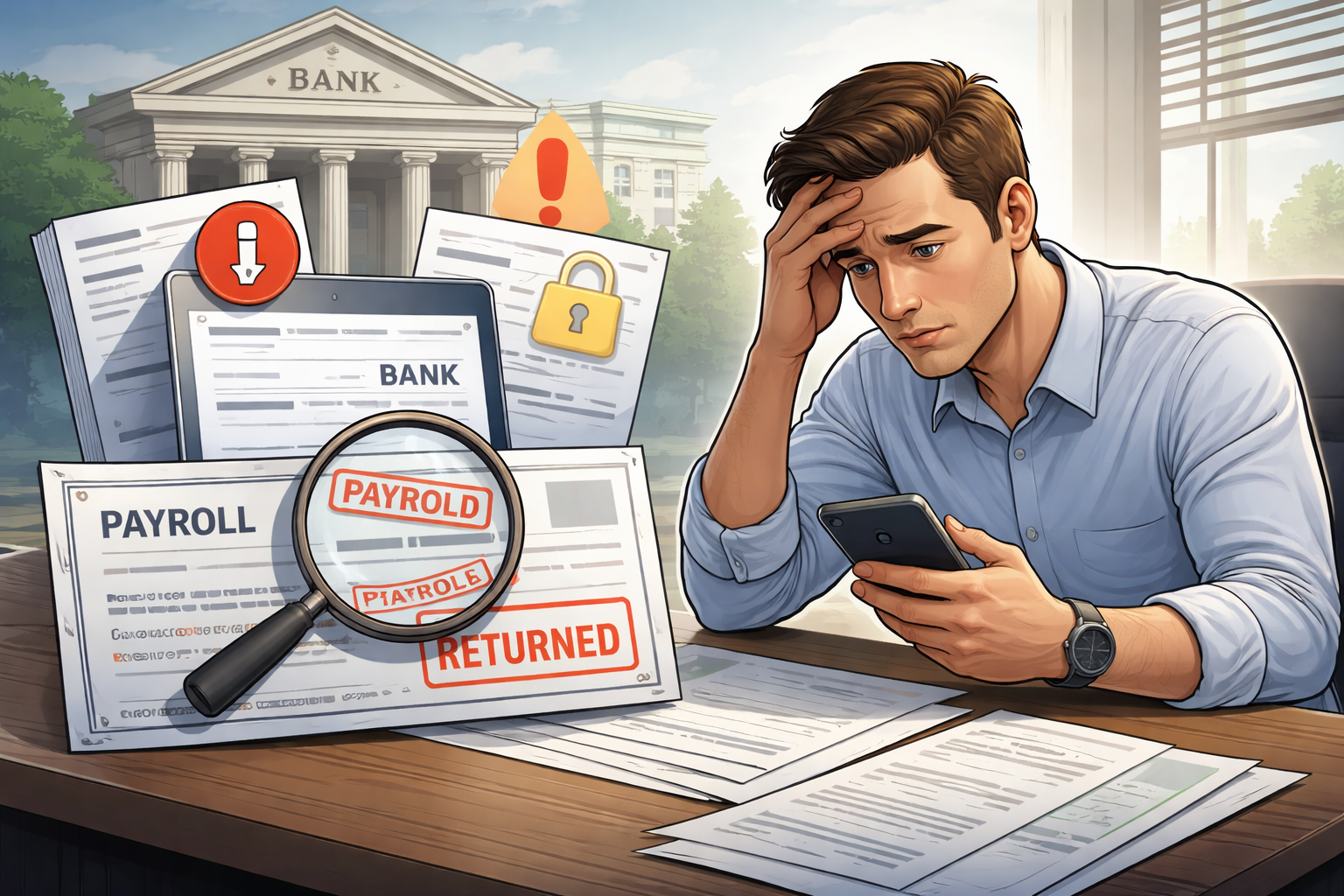
Payroll processed but rejected by bank due to name mismatch causing delayed payment was the phrase I heard only after payday had already come and gone. Until then, the situation looked ordinary. My pay stub was there. Payroll showed complete. The deposit date had arrived. But my account balance stayed exactly where it had been the night before.
The first reaction was not panic. It was disbelief. I refreshed my banking app, checked again during lunch, then once more before leaving work. Nothing. When I finally asked HR, they said the payment had already been processed. That was the moment the problem became more dangerous than a normal late paycheck, because the company believed the payment had already left their side.
Payroll processed but rejected by bank due to name mismatch causing delayed payment is one of the most confusing pay problems because the failure often happens after payroll closes its run. The payroll team may be looking at a completed batch. The employee is looking at an empty bank account. The bank has already rejected the incoming deposit file or returned it. For a short period, every side is looking at a different version of the same payment.
If you need a broader starting point before you compare your own situation, this hub explains how payroll problems usually unfold and what employees should do first.
Why This Problem Feels So Wrong on Payday
Most paycheck delays make at least some visible sense. A timesheet was not approved. A payroll cycle changed. A direct deposit setup was incomplete. This one feels different because payroll processed but rejected by bank due to name mismatch causing delayed payment creates the illusion that everything was done correctly. On paper, the company may have already paid you. In real life, you still cannot use the money.
The emotional pressure comes from the mismatch between system status and lived reality. You may hear phrases like “it was sent,” “it shows paid,” or “we completed payroll on time.” Those statements can all be technically true while your deposit is still missing. That is exactly why employees often waste the first one or two days asking the wrong question. Instead of asking whether payroll was processed, you need to ask whether the bank accepted the deposit and whether any return notice has been received.
What Usually Triggers the Name Mismatch
Payroll processed but rejected by bank due to name mismatch causing delayed payment usually starts with a detail that looked too small to matter. That is why this problem catches people off guard. Common triggers include a legal name that does not exactly match the name held by the bank, a recent name change after marriage or divorce, a payroll profile built from onboarding paperwork that used a shortened name, or a bank account that is technically owned under a different naming format.
Some employees run into this after updating HR records but not updating their bank. Others update their bank first and assume payroll will still work with an older name. There are also situations where the payroll provider truncates a middle name, drops a suffix, removes punctuation, or formats the first and last name differently than the bank expects. Not every bank applies the same level of matching scrutiny, but when the bank does apply it, the rejection can happen quickly and quietly.
What Actually Happens Between Payroll and the Bank
Once payroll releases a direct deposit batch, the payment enters a separate path that the employee cannot see. The payroll platform sends payment instructions. The banking network receives them. The receiving bank reviews the account and identifying information tied to that incoming transaction. If the bank decides the information does not match closely enough, the deposit may be rejected and returned.
At that point, payroll processed but rejected by bank due to name mismatch causing delayed payment becomes a reconciliation problem. It is no longer just a “Where is my money?” question. The funds may be in transit back to the employer or payroll provider. The company may not yet see the return. The employee may still have no proof except the absence of the deposit. This lag between rejection and visible return is where the worst confusion happens.
What HR Sees, What the Bank Sees, What You See
The reason this problem drags is that each side sees only part of the sequence.
HR or payroll may see:
– payroll batch completed
– pay statement generated
– payment marked released
– no immediate hard error on the employee screen
The bank may see:
– incoming ACH or direct deposit item
– account information present
– name validation concern or mismatch
– rejection and return workflow triggered
You may see:
– no money in the account
– no bank notification
– no clear explanation from payroll yet
– growing urgency because bills are tied to payday
That is why this problem often looks like denial from the employer even when the real issue is a delayed feedback loop between systems.
Detailed Situation Breakdown
Situation 1: Your payroll record uses a shortened first name
You use Mike at work, but your bank account is under Michael. That may have worked elsewhere, but this payroll run hit a stricter validation path. The deposit can be returned even though the account number itself is correct.
Situation 2: You recently changed your legal name
Your employer updated the new name, but the bank still has the prior one, or the reverse happened. This is one of the most common reasons payroll processed but rejected by bank due to name mismatch causing delayed payment appears right after life changes.
Situation 3: The account is shared but not set up the way payroll assumes
Employees sometimes send payroll to an account they use regularly but that is formally structured under another naming arrangement. That can produce acceptance problems depending on the bank and account setup.
Situation 4: A suffix, middle name, or punctuation changed the match result
Jr., Sr., hyphenated last names, apostrophes, or multiple last names can create formatting gaps between systems. The employee thinks everything matches because the words are close enough, but the system treats them differently.
Situation 5: The bank rejected it, but payroll has not received the return file yet
This is the most frustrating version. HR says it was sent. The bank will not always explain much. Your money is effectively between steps. It has failed, but the failure is not yet visible to the employer in a usable way.
Situation 6: Payroll corrected the name, but reissue has not been approved
Even after the cause is found, a second delay may happen because the original funds must return, be reconciled, and then be released again through a new payment method or next-day exception run.
Finding your exact version matters, because the fix for a return-in-progress is different from the fix for a bad profile that has not yet been corrected.
How Long It Usually Takes
Payroll processed but rejected by bank due to name mismatch causing delayed payment rarely resolves the same day. The timeline often stretches because there are two separate clocks running: the return clock and the reissue clock.
A common sequence looks like this:
– payday morning: no deposit appears
– same day or next business day: employee reports issue
– one to three business days: rejection becomes visible in return flow
– additional one to three business days: payroll reconciles returned funds
– then reissue timing depends on employer policy
Some employers can issue an off-cycle payment or live check once they confirm the return. Others wait until the returned amount is fully posted back. The money is often recoverable long before it is available to you again, and that gap is where employees suffer the most.
What To Ask HR Right Now
If you want to move this faster, do not send vague messages like “My deposit is missing.” Ask targeted questions.
Use questions like these:
– Was my direct deposit accepted by the bank, or has it been returned?
– What exact name was included on the payroll deposit file?
– Has the payroll provider posted a return code or rejection notice yet?
– Once the funds return, can you issue a manual check or off-cycle payment?
– Has my direct deposit profile already been corrected for the reissue?
Payroll processed but rejected by bank due to name mismatch causing delayed payment gets fixed faster when the employer understands you know the difference between “processed,” “accepted,” and “reissued.” Those are not the same stage, and treating them as the same wastes time.
What Your Bank Can and Cannot Do
Your bank can sometimes confirm whether an incoming deposit was rejected, but many front-line bank representatives will not be able to explain the full payroll side. That is why employees lose time bouncing between payroll and the bank. The bank may confirm there is no deposit. Payroll may confirm the payment was sent. Both answers can be true and still incomplete.
The bank usually cannot reissue your wages. The employer or payroll provider must do that after the failed item is recognized and the record is corrected. So the goal of calling the bank is not to demand the money from them. It is to confirm whether the rejection theory matches what happened.
Mistakes That Make The Delay Worse
Employees often make this problem worse by waiting through the weekend, assuming the money will eventually show up, or changing their bank details too many times before payroll confirms the actual cause. Another common mistake is accepting a vague answer like “It’s processing” when payroll processed but rejected by bank due to name mismatch causing delayed payment may already have moved into return status.
Do not do these things:
– do not wait until the next payroll cycle before following up
– do not assume the account number being correct means the name cannot be the issue
– do not let payroll reissue to the same unverified profile
– do not rely only on verbal reassurance without a timeline
The fastest fix usually comes from forcing the problem into a specific stage: sent, rejected, returned, corrected, or reissued.
How This Differs From Other Missing Pay Problems
This article should stay separate from your other payroll posts because the core cause here is not a payroll run failure, a timesheet sync failure, or a compliance hold. It is a bank-side acceptance failure after release. That makes it structurally different from “payroll marked as processed but payment not sent,” “payroll showing as processing but funds not released,” or “employee locked out of payroll system before payday.”
If your employer claims pay was sent but the bank shows nothing useful, this related article helps compare scenarios and separate a name mismatch rejection from other missing-deposit patterns.
What Happens After The Return Comes Back
Once the failed deposit is formally returned, the employer or payroll provider usually has to reconcile the amount, remove the failed direct deposit from the employee record, confirm corrected bank or name information, and choose a reissue method. Payroll processed but rejected by bank due to name mismatch causing delayed payment does not end when the bank rejects it. It ends when the corrected payment is actually put into your hands or deposited successfully.
This internal step is where some employees are told to wait for the next cycle. Others can request a paper check, same-day manual payment, or emergency exception depending on company policy. If your rent, utilities, or other scheduled payments are tied to that missed payday, you should push for a specific reissue path instead of accepting a generic promise.
FAQ
Can payroll show paid even when my bank never received usable funds?
Yes. Payroll processed but rejected by bank due to name mismatch causing delayed payment can still appear as completed on the payroll side before the returned item is fully reflected.
Does this mean the employer did nothing wrong?
Not necessarily. The employer may still have outdated or badly formatted information in your payroll profile. But the immediate failure point is often the bank’s acceptance check.
Will the money disappear?
Usually no. The issue is typically delay and reissue, not disappearance. The real risk is how long you go without access to wages that were supposed to arrive on payday.
Should I ask for a paper check?
If the return has been confirmed and the profile is corrected, asking for a manual check or off-cycle reissue is often reasonable, especially when the missed payday creates hardship.
Key Takeaways
– Payroll processed but rejected by bank due to name mismatch causing delayed payment is a bank acceptance failure after payroll release, not just a late deposit.
– The most confusing part is the delay between rejection and payroll visibility.
– Name differences that seem minor can still trigger a return.
– The right questions are about acceptance, return, correction, and reissue.
– This topic stays distinct from your other payroll posts because the root layer is bank rejection, not payroll non-processing.
If you are dealing with this now, the next helpful read is the article below. It fits naturally near the conclusion because it helps you respond once the money was processed but still never reached you in usable form.
Payroll processed but rejected by bank due to name mismatch causing delayed payment does not feel like a paperwork error when you are living through it. It feels like your money vanished into a system that keeps telling you everything is fine. That is why people lose precious days waiting politely instead of pressing for the real status.
I would treat this as urgent the moment payday passes without the deposit. Ask whether the bank accepted the deposit, ask whether a return has been posted, confirm the exact name used, and push for a corrected reissue path immediately. Do not let the conversation stop at “It was processed.” That answer is too early in the chain to help you.
For official wage and pay information, refer to the U.S. Department of Labor here: U.S. Department of Labor wage guidance.